Cleaning for Infection Prevention in Medical and Dental Offices
How to build an infection prevention cleaning protocol for medical and dental offices, covering high-touch surfaces, contact times, room sequencing, terminal cleaning and documentation.
A medical or dental office is judged on infection prevention, not on how clean it looks. That is the whole design constraint: patients and regulators care whether pathogens were removed, not whether the waiting room looks tidy.
This guide is about building that protocol — the surfaces, the sequence, the timings and the records. It assumes you already have the room-by-room task list from the medical office cleaning checklist; here we are dealing with the how and the why.
Scope reminder: clinical waste, sharps, instrument reprocessing and body-fluid spills are normally the practice's responsibility under its infection prevention and control policy. Confirm in writing what is in scope. Where the practice's policy is stricter than anything here, theirs wins.
Key takeaways
- Priority follows hand-to-surface contact, not floor area.
- Clean first, then disinfect, and respect the full contact time.
- Sequence rooms and equipment so contamination is never carried from dirty to clean.
- The practice's own IPC policy overrides your standard procedure — always ask for it.
- Documentation is not optional in clinical space; it is part of the deliverable.
Risk classification of surfaces
Use the Spaulding-style logic that clinical settings already use, applied to cleaning.
| Category | Examples | Requirement |
|---|---|---|
| High-touch, clinical contact | Exam tables, chair controls, delivery unit handles, blood pressure cuffs, keyboards | Clean and disinfect between patients |
| High-touch, non-clinical | Door handles, light switches, call bells, waiting room arms, taps | Clean and disinfect frequently, at least daily |
| Low-touch clinical | Cabinets, walls, floors in treatment areas | Clean daily, disinfect on schedule |
| Low-touch general | Ceilings, high ledges, floors in admin areas | Clean on a periodic cycle |
The high-touch rows are where infection prevention is won or lost. They are small, easy to miss visually, and touched constantly.
The core protocol
Apply this to every clinical and high-touch surface.
- Assess which surfaces in the room are high-touch or clinical contact. Do this from the practice's policy, not from memory.
- PPE on — gloves at minimum, and more depending on the task and product.
- Clean — remove visible soil and organic matter. Disinfectants do not work through soil.
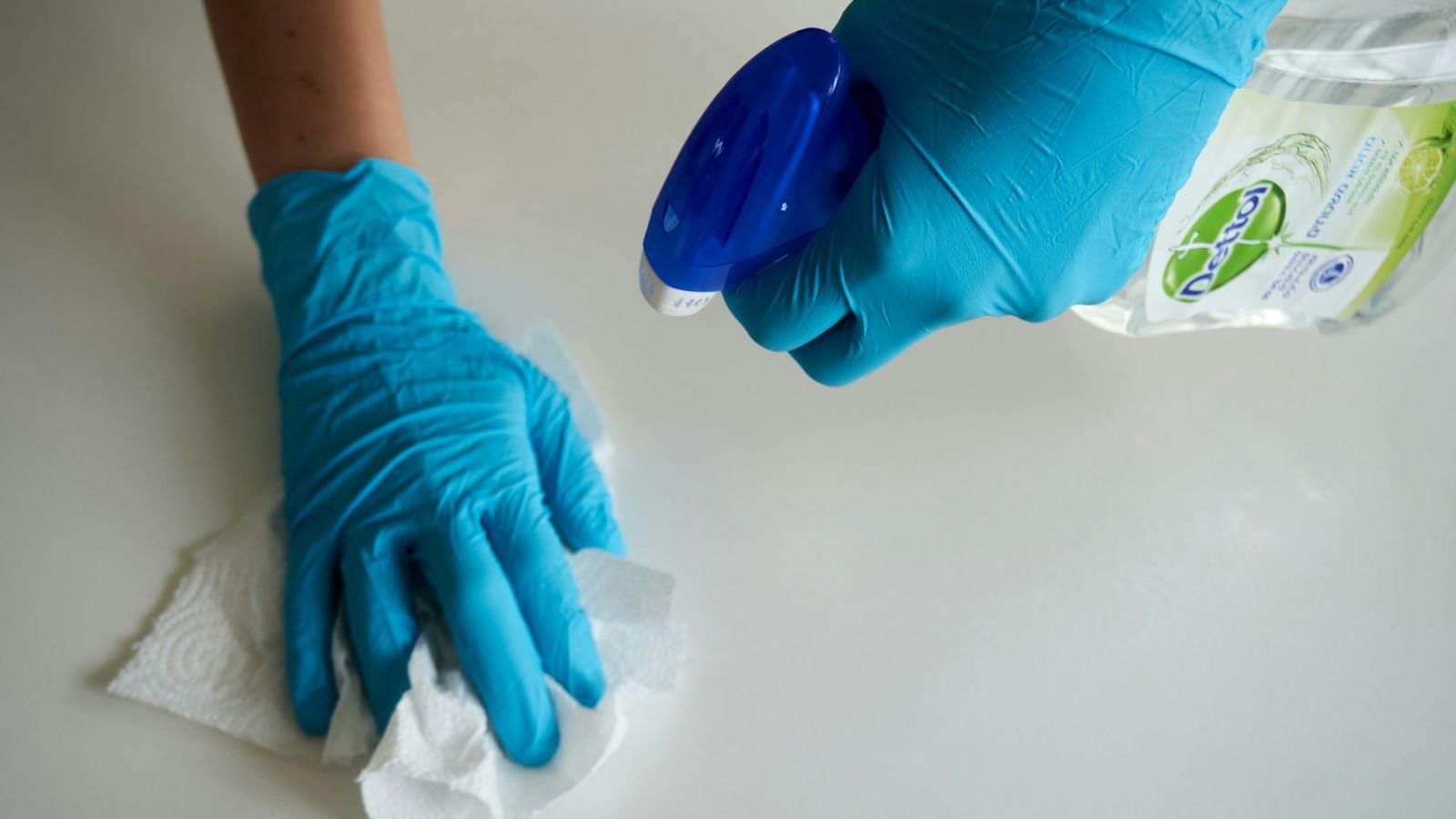
- Disinfect — apply the practice-approved product at the correct dilution.
- Wait the full contact time — the surface stays wet for the stated dwell time. This is the step that fails most often.
- Dry or allow to air dry as the product specifies.
- Change cloths between surfaces in critical areas, and between risk zones always.
- Work clean to dirty within the room, and never return to a clean area with a used cloth.
- Remove PPE correctly and wash hands.
- Record, if the practice's policy requires it.
Contact time is the discipline. The wider chemistry is covered in cleaning vs sanitizing vs disinfecting and in infection control cleaning.
Sequencing: the part that prevents cross-contamination
Getting the order wrong undoes good technique. Work in this sequence:
Within a building: admin and non-clinical areas → waiting areas → non-clinical corridors → clinical areas → washrooms last.
Within a room: high surfaces → mid surfaces → low surfaces → floor. Clean from least contaminated to most contaminated, and finish at the door.
Between rooms: change cloths and mop heads, or use a fresh side. Never carry a cloth from one exam room into another, and never from a washroom into a treatment room.
Equipment discipline:
- Colour-coded cloths and mops, used consistently, stored separately.
- Mop heads laundered or replaced on a schedule appropriate to clinical use.
- Buckets emptied and cleaned between areas, not topped up through the day.
- Vacuums with appropriate filtration in clinical settings, where permitted at all.
Terminal and enhanced cleaning
These are extra levels beyond routine, and they need defining in the contract.
Terminal cleaning happens when a room is taken out of use — after a procedure, an infectious patient, or at the end of a session. It is more thorough than routine: all surfaces, all high-touch points, both cleaning and disinfection, with attention to areas routine cleaning skips.
Enhanced or outbreak cleaning follows an infectious incident or during an outbreak period. It typically involves more frequent disinfection, dedicated equipment, sometimes different products, and additional documentation. It may be outside a routine cleaning contract, and often requires client direction and sometimes specialist involvement.
Do not improvise either. Ask the practice which level applies and record what was instructed.
The practice's IPC policy comes first
Every clinical practice has, or should have, an infection prevention and control policy. It governs:
- Which products are approved, and at what dilution
- Which surfaces require disinfection versus cleaning
- Any additional requirements for specific areas or equipment
- What is out of scope for cleaning staff
- Documentation expectations
Ask for it in writing before starting. If it conflicts with your standard procedure, follow theirs, and if it conflicts with safe practice, raise it rather than working around it.
Documentation
In clinical space, an undocumented clean is very close to an unperformed clean, because the whole point is defensibility.
Record:
- What was cleaned and disinfected, and when
- Which product and at what dilution, where the policy requires it
- Any exceptions — areas not accessed, equipment not available
- Any findings — damage, contamination, expired stock, unsafe practice
- Corrective actions and their dates
This is the same structure as deficiency tracking and it produces the kind of record a practice manager can file and a regulator can review.
Training and competence
Infection prevention cleaning is a skill, and clinical settings punish improvisation.
- Staff must understand why cleaning precedes disinfection.
- They must know the approved products and their contact times.
- They must understand PPE selection, use and removal order.
- They must know the sequence rules and why they exist.
- They must know what they are not permitted to touch or handle.
- New starters should be supervised in clinical areas until competence is confirmed.
See training and onboarding cleaning staff for structure, and the WHMIS guide for the chemical safety side.
Inspecting infection prevention
Verify the process, not just the appearance, because a clean-looking surface can fail.
Score these as critical every inspection:
- Exam tables and clinical contact surfaces clean and disinfected
- High-touch hardware clean across all areas
- Sinks clean and dry, no standing water
- Soap, towel and sanitiser stocked
- Washroom fixtures clean, floors dry
- Correct product in use at correct dilution
- Contact times being observed (process check)
- Cloths and mops correctly colour-coded and not cross-used
- Chemical storage labelled and secured
- No expired products in use
- Documentation completed
For the general method see what a cleaning inspection is, and for trend tracking, how to measure cleaning quality.
For the wider obligations around chemicals, PPE and incident reporting, see our health and safety guide for Canadian cleaners.
Frequently asked questions
How often should a medical office be cleaned and disinfected?
Daily cleaning of all areas with disinfection of high-touch surfaces, with clinical contact surfaces cleaned and disinfected between patients where the practice assigns that to cleaning staff. Busy practices and those with vulnerable patients may need multiple daily passes.
What is terminal cleaning in a medical office?
A more thorough clean performed when a room is taken out of use, covering all surfaces and high-touch points with both cleaning and disinfection. It exceeds routine requirements and is usually specified by the practice's infection prevention policy.
Which disinfectant should be used in a dental or medical office?
Only products the practice has approved under its infection prevention and control policy, applied at the specified dilution and for the full contact time. Product approval is a clinical decision, not a cleaning decision.
Are cleaners responsible for disinfecting dental equipment?
No. Instrument reprocessing, sterilisation and regulated equipment handling are clinical functions. Cleaning staff typically handle environmental surfaces only, as defined by the practice's policy.
How do you avoid cross-contamination between rooms?
Work from least to most contaminated areas, clean from high to low within a room, change cloths and mop heads between rooms, use colour-coded equipment consistently, and never carry a cloth from a washroom or a dirty area into a clinical space.
Make the record the deliverable
In clinical settings the paper trail is part of the service. A practice that can show its cleaning was performed to protocol is protected; one that cannot is exposed.
NeatScore lets you build clinical checklists with process and contact-time items flagged critical, record per-room completion with photos, and produce a dated report the practice can file. Try it free for 7 days, or see pricing.