Hard Floor Cleaning: Methods, Machines and When to Use Each
A practical guide to hard floor cleaning methods — dust mopping, damp mopping, auto-scrubbing, burnishing and machine scrubbing — and which to use on which floor.
Hard floors are cleaned with five methods, and most buildings use the wrong one. Damp mopping a large lobby by hand wastes hours; auto-scrubbing a small washroom wastes money. Neither achieves the result the floor actually needs.
This guide covers hard floor cleaning methods, what each is for, and how to match them to the floor and the building.
Key takeaways
- Use the least aggressive method that achieves the standard. Aggression costs money and shortens floor life.
- Dust mopping before wet cleaning is not optional — wetting grit grinds it into the finish.
- Auto-scrubbers are for large open areas; hand methods are for edges, corners and small rooms.
- Burnishing restores gloss; it does not clean. Never burnish a dirty floor.
- Match chemistry to the floor. The wrong product causes permanent damage.
The five methods
| Method | What it removes | Best for | Frequency |
|---|---|---|---|
| Dust mopping / sweeping | Dry soil, grit, debris | All hard floors, before any wet work | Daily |
| Damp mopping | Light soil, spills | Small areas, edges, washrooms, spot work | Daily |
| Auto-scrubbing | Embedded soil and old finish | Large open areas: lobbies, corridors, retail | Weekly to monthly |
| Machine scrubbing / buffing | Heavy soil, scuffing | Mid-size areas, deep cleans | Monthly, or as needed |
| Burnishing | Nothing — it restores gloss | Finished floors after cleaning | Weekly to monthly |
A sixth method exists above these: stripping and sealing, which resets the finish entirely and is covered in the commercial floor care guide; for soft flooring see commercial carpet cleaning. It resets the finish entirely. That is covered separately in the floor stripping and sealing guide.
1. Dust mopping and sweeping
The most important and most skipped step.
- Removes the grit that abrades finish and scratches the floor underfoot.
- Always do it before wet cleaning. Dust mopping takes minutes; refinishing a scratched floor takes a weekend.
- Use a treated dust mop for large areas, a broom for coarse debris, and a vacuum with a hard-floor tool for fine dust in corners.
- Work in overlapping lanes, and turn the mop rather than dragging soil back over cleaned floor.
- In entrances, this happens multiple times a day in winter. See front of house cleaning.
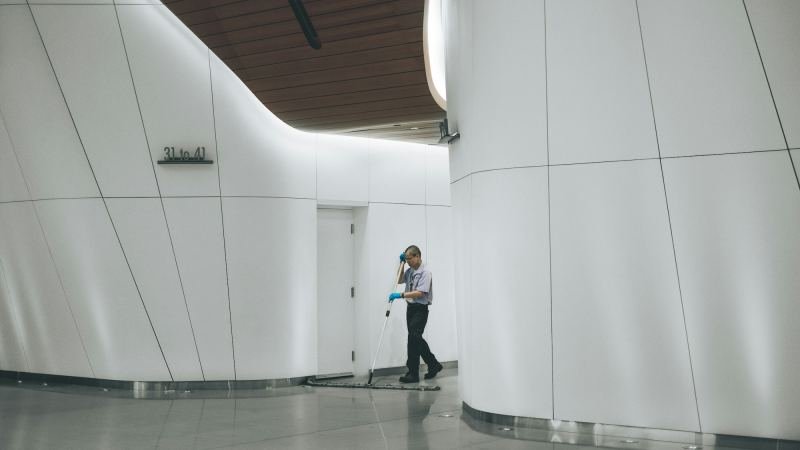
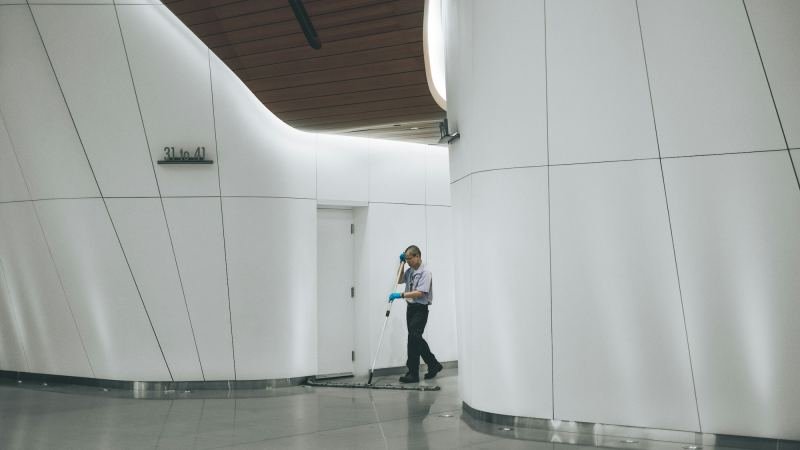
2. Damp mopping
The workhorse for small areas, and the most commonly misused method.
- Damp, not wet. A mop that leaves standing water is damaging finish and creating a slip hazard.
- Change the water frequently. Dirty water redistributes soil and leaves a film.
- Use two-bucket or, better, flat-mop systems with fresh solution to avoid re-soiling.
- Work from the far end toward the exit so you do not walk over cleaned floor.
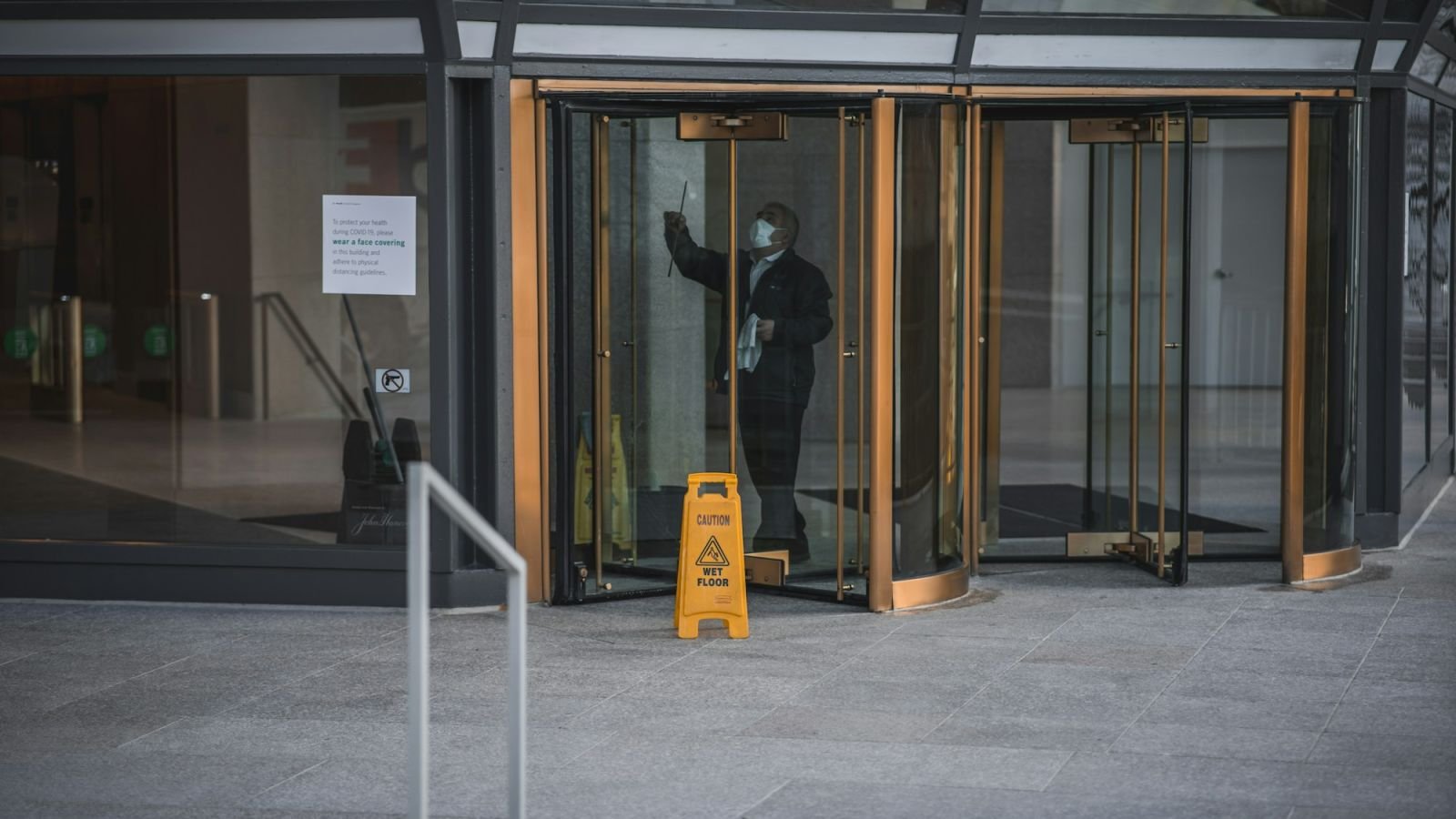
- Sign wet floors and remove signage only once dry. The CCOHS guidance on slips, trips and falls explains why this matters.
- Do not use damp mopping as a substitute for auto-scrubbing on large floors. It is slow and it does not remove embedded soil.
3. Auto-scrubbing
For large areas, this is both faster and better than hand methods.
- How it works: applies solution, agitates with a cylindrical or disc brush, then vacuums the slurry up in one pass.
- Use it on: lobbies, long corridors, retail floors, warehouses, dining areas — anywhere open and larger than roughly a small room.
- Choose the brush or pad for the floor type. Aggressive brushes damage soft or delicate flooring.
- Do not over-wet. Excess solution gets into seams and edges and damages adhesive.
- Follow with edge work. Auto-scrubbers cannot reach edges, corners or under fixtures. Detail those by hand — this is where scrubbing-only cleaning looks unfinished.
- Route deliberately: long straight passes, minimal overlapping, and keep the machine off wet floor signage areas.
- Maintain it. A clogged squeegee or worn brush produces streaked floors and doubles the work.
4. Machine scrubbing and buffing
For deeper cleaning and for mid-sized areas where an auto-scrubber is impractical.
- Rotary scrubbing with a suitable pad or brush lifts heavier soil and old finish.
- Buffing uses a lower-speed machine with a pad to clean and lightly restore gloss.
- Useful for periodic deep cleans, pre-recoat preparation, and problem areas.
- Requires more operator skill than an auto-scrubber. Training matters, particularly on edges and transitions between floor types.
- Always test on an inconspicuous area first when the floor type is unfamiliar.
5. Burnishing
Restores appearance, adds nothing.
- A high-speed machine generates heat that flows the finish and brings up gloss.
- It cleans nothing. Burnishing a soiled floor grinds dirt into the finish and dulls it permanently.
- Always clean or dust mop first, and pair burnishing with a regular recoat programme, because burnishing wears the finish down over time.
- Frequency depends entirely on traffic: entrance lobbies may need weekly burnishing, back corridors monthly.
- Do not burnish floors with soft or unwaxed finishes unless the manufacturer says it is appropriate.
Matching method to floor type
| Floor type | Suitable methods | Avoid |
|---|---|---|
| Vinyl and VCT | All five, plus stripping and sealing | Excess water at seams |
| Polished stone | Dust mop, damp mop with pH-neutral, auto-scrub with soft pad | Acidic cleaners, abrasives — they etch |
| Terrazzo | Dust mop, damp mop, auto-scrub, burnish | Acidic cleaners |
| Quarry and ceramic tile | Damp mop, auto-scrub, machine scrub; grout needs attention | Over-wetting grout lines |
| Sealed concrete | Auto-scrub, machine scrub, damp mop | Acidic cleaners on the sealer |
| Rubber and gym flooring | Damp mop, auto-scrub with appropriate pad | Solvents, excess water — degrades the surface |
| Timber and laminate | Dust mop, barely-damp mop | Free water, steam, abrasives |
When the floor type is unclear, ask the client or test in an inconspicuous area. The cost of a wrong product is usually a permanent mark, and occasionally a full floor replacement.
Sequencing a full clean
Correct order matters more than equipment quality. The sequence:
- Clear and prepare — move what can be moved, protect what cannot, place signage.
- Dry clean — dust mop or vacuum the whole area, including edges.
- Edge and detail — hand-clean edges, corners and around fixtures while the main floor is still dry.
- Wet clean — auto-scrub or damp mop, working in logical lanes from the furthest point.
- Detail again — touch up edges the machine missed.
- Dry and check — remove signage when genuinely dry, then inspect the result.
- Restore — burnish or recoat if part of the programme.
Skipping step 2 is the single most common cause of streaked, dull-looking floors after a thorough scrub.
Inspecting hard floors
Score floors every inspection, since they are the surface clients judge first.
- Visible soil, film or streaks
- Scuff marks and heel marks
- Dulling or worn finish in traffic lanes
- Edges and corners — the giveaway of machine-only cleaning
- Under and behind fixtures
- Wet patches and slip risk (critical)
- Wet floor signage in place during work (critical)
- Drains and thresholds clear and dry
Because floors deteriorate slowly, the trend is more informative than a single score. Our guide to measuring cleaning quality covers how to track it.
Floors are scored like any other surface, so agree a target first. Our guide to APPA cleanliness levels explains the scale and which level suits which area.
Frequently asked questions
What is the best way to clean a commercial hard floor?
Dust mop or vacuum first, then use the least aggressive wet method that achieves the standard — damp mopping for small areas and edges, and an auto-scrubber for large open floors. Always detail edges by hand afterwards.
How often should hard floors be machine scrubbed?
Weekly to monthly depending on traffic. Entrances and busy circulation areas need it more often, while back-of-house areas can go longer. Dust mopping and damp mopping happen daily.
Can you use a mop on all hard floors?
Damp mopping is safe on most sealed hard floors if the mop is genuinely damp rather than wet, but timber and laminate need minimal moisture, and polished stone requires pH-neutral product. Free water damages seams, adhesive and some finishes.
Do you need to dust mop before damp mopping?
Yes. Wetting grit and soil before removing it grinds it into the finish, causing scratching and dullness. Dust mopping first is the cheapest quality improvement available in hard floor cleaning.
What is the difference between buffing and burnishing?
Buffing uses a lower-speed machine to clean and lightly improve appearance. Burnishing uses a high-speed machine whose heat flows the finish for a higher gloss. Neither cleans deeply, and both require a clean floor and a maintained finish system.
Train the method, then verify the result
Method and equipment only get you so far. The standard is met when someone checks the floor and scores it against an agreed target.
NeatScore lets you score hard floors by area with photos attached, so you can see whether your methods are actually holding the finish and where edge work is being missed. Try it free for 7 days, or see pricing.